
Installation and commissioning
Instructions for installation and commissioning.
Product Identification
Product designation | Item No. | E-number (SE) |
|---|---|---|
300W 2HE SINE UPS | 2U02U0021FP003 | 52,137 92 |
SIN - UPS Product sheet / technical data
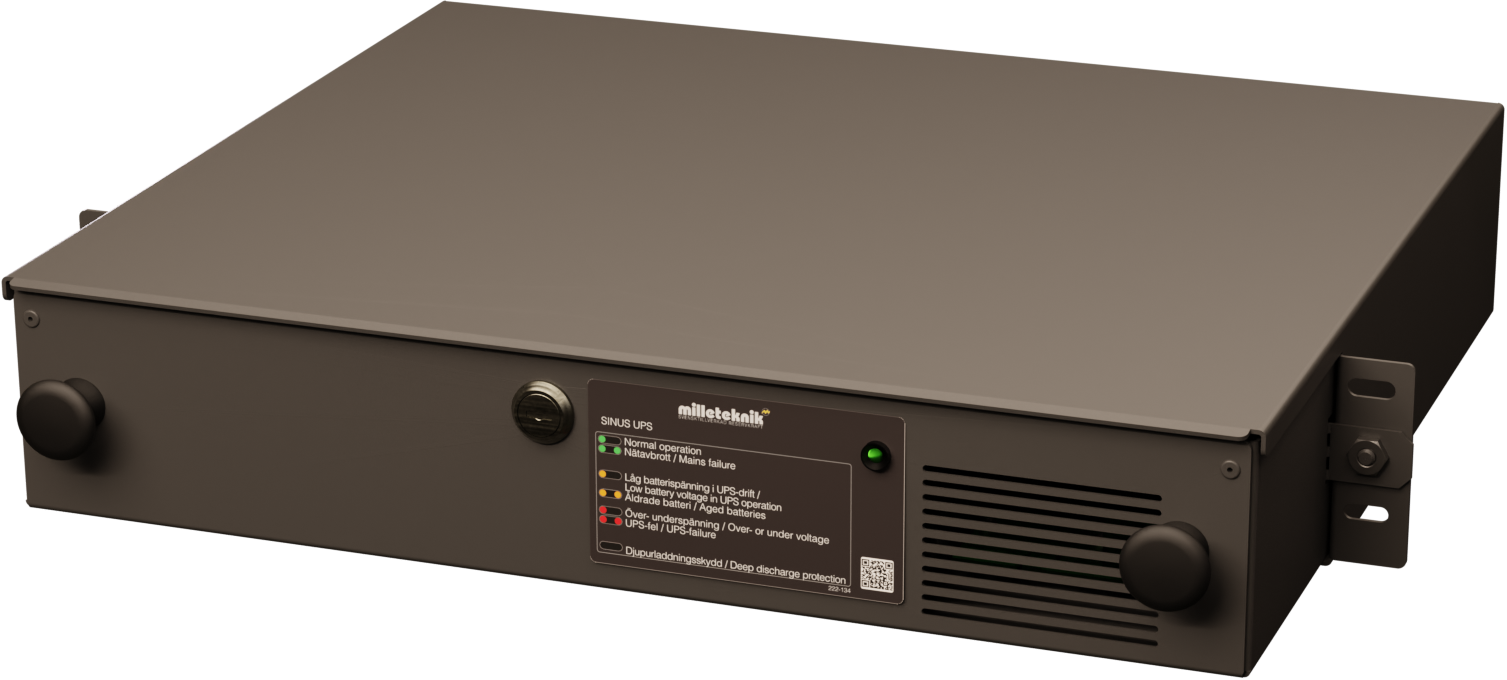
Technical description
Compact 2-HE rack-mounted UPS for 19" racks with 300 W continuous power and space for 2 × 12 V 20 Ah batteries. Prepared for communication via relay outputs as well as the possibility of Modbus and compatible with external battery box (4 ×
Revisions and the edition of this document
The current and most recently published edition of this document is available at www.milleteknik.com.
The validity of this document can not be guaranteed, as new editions are published without prior notice.
Original instructions for use: Swedish.[1].
Instructions for use, technical data and translations thereof may contain errors. It is always the responsibility of the installer to install the product in a safe manner.
Symbols
Symbols | Name | Explanation |
|---|---|---|
 | Warning | Risk of electric shock, improper installation or hot surfaces. Appears in some manuals |
 | Note | Used for supplementary information that clarifies the text. |
 | Caution/Important | Indicates the risk of equipment damage or malfunction. Also used for information that is important but not security-related |
 | Tips | Displays practical advice or shortcuts for installation, operation, or service. |
 | CE marking | The product complies with applicable EU directives and harmonised standards. |
 | Read the manual | Please read manual before installation and service. |
 | Do not dispose of in household waste | The product is covered by the WEEE Directive and must not be disposed of with household waste, it must be recycled and delivered to a recycling centre. |
 | Recycling | Packaging, products and other materials that do not contain electronics must be recycled in accordance with local environmental regulations. |
Installation - general information - UPS
Installation shall be carried out by a competent electrician in accordance with the applicable national electrical installation rules.
The product is of protection class I and must be connected to a grounded 230 V AC circuit. The output of the UPS can be energized even when the incoming mains voltage is disconnected
A main switch according to IEC 60947-1 shall be provided in the fixed installation. The switch should be easily accessible and marked with its operation
The incoming supply cable shall be dimensioned according to the applicable installation rules and protected with an appropriate fuse.
Outgoing 230 V AC from the UPS should be installed in such a way that it is clearly visible that the circuit can be supplied with backup power.
AC cables and low voltage cables must not be pulled together. Keep separate cable chutes or bundles
Check that protective earth (PE) is properly connected before turning on voltage.
Check that both the incoming and outgoing 230 V AC are properly connected before commissioning.
Ensure free air circulation around the enclosure, at least 100 mm unless otherwise specified. Ventilation openings must not be covered.
The product is intended for indoor installation in normal environment, pollution number 2 and indoor class 1.
The cable area for incoming and outgoing 230 V AC shall be at least 1,5 mm², unless otherwise specified in the technical data of the product. The cable area and clearance shall always be adjusted according to the rated current of the product and the applicable installation rules.
Enclosures
General assembly instructions
Indoor mounting in 19" rack
The product should be mounted in a standardized 19" rack or cabinet with sufficient carrying capacity for the weight of the enclosure including batteries.
The device should be mounted at a comfortable working height, normally between 1.4 and 1.8 m.
The device is mounted horizontally in the rack with the included rack ears or corresponding brackets.
Check that the rack posts are properly aligned and that the spacing corresponds to the 19" standard (465—470 mm between the inner edge of the posts).
When assembling, cage nuts or locking washers should be used to ensure that the screws fit securely.
For good ventilation, at least 100 mm of free space should be provided above and below the unit. Do not block the air flow on the front or back.
Batteries should always be placed as directed and must not block ventilation openings or wiring.
Installation shall be carried out in accordance with the applicable installation rules and by a competent installer.
Mounting
Use the appropriate screw for mounting on a wall or in a 19" rack. Screws for mounting on a wall or in a rack are not included.
For wall mounting in concrete, concrete screws must be used. For rack mounting, M6 with basket nut is used
Screw length should be adjusted according to wall material and load. The specified screw length is the minimum allowable length
Mounting holes, spacing and ø.
Weight with batteries
Net weight without batteries | Battery type | Number | Batteries/weight per piece | Weight with batteries |
|---|---|---|---|---|
13 kg | 20 Ah | 2 | 6.0kg | 25kg |
Mounting the 19" rack box
Check that the cover is fastened with the supplied nuts.
Place the box in the desired position in the 19" rack.
Screw the box on both sides into the rack profile with screws designed for 19" racks.
Warning
Do not insert the batteries until the rack box is properly assembled and securely attached to the rack. The weight of the batteries can make the box unstable if it is not properly bolted
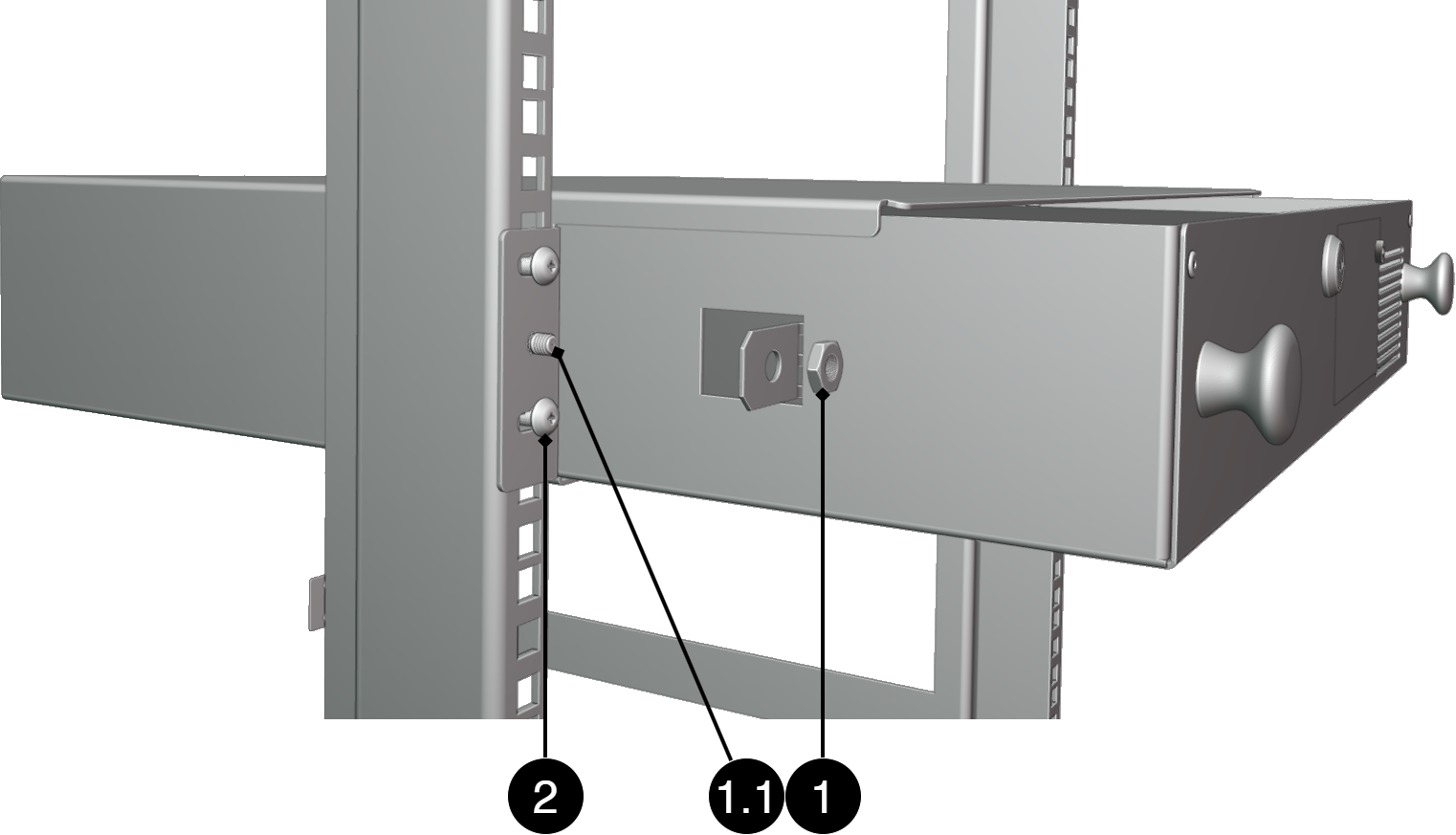
No. | Explanation |
|---|---|
1, 1.1 | Nut for fastening caps. Nut included |
2 | Screw for mounting in 19" rack. Screws are not included. |
Component overviews
Component Overview
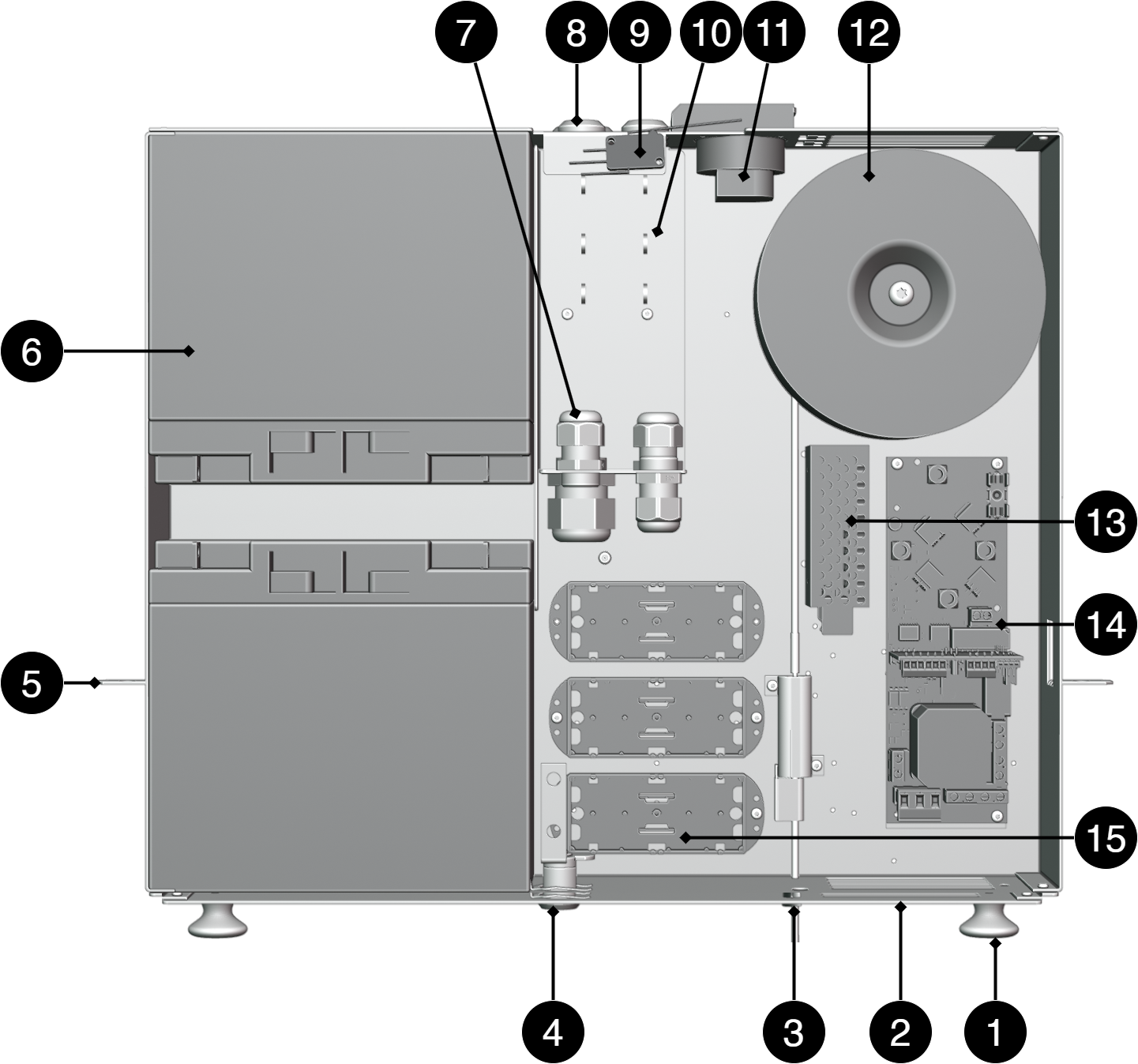
No. | Explanation |
|---|---|
1 | Knob to pull out the box. |
2 | Enclosure sheet. |
3 | Indication diode. |
4 | Lock. |
5 | Bracket for nut in 19" rack stand. |
6 | Place for batteries. Batteries are not included but ordered separately |
7 | Strain relief for wiring. |
8 | Cable grommets. |
9 | Sabotage contact. |
10 | Place for cable ties to strip cable. |
11 | Connector for output 230 V AC. |
12 | Transformer. |
13 | Power supplies. |
14 | Motherboard. |
15 | Optional card location, optional availability varies with configuration. |
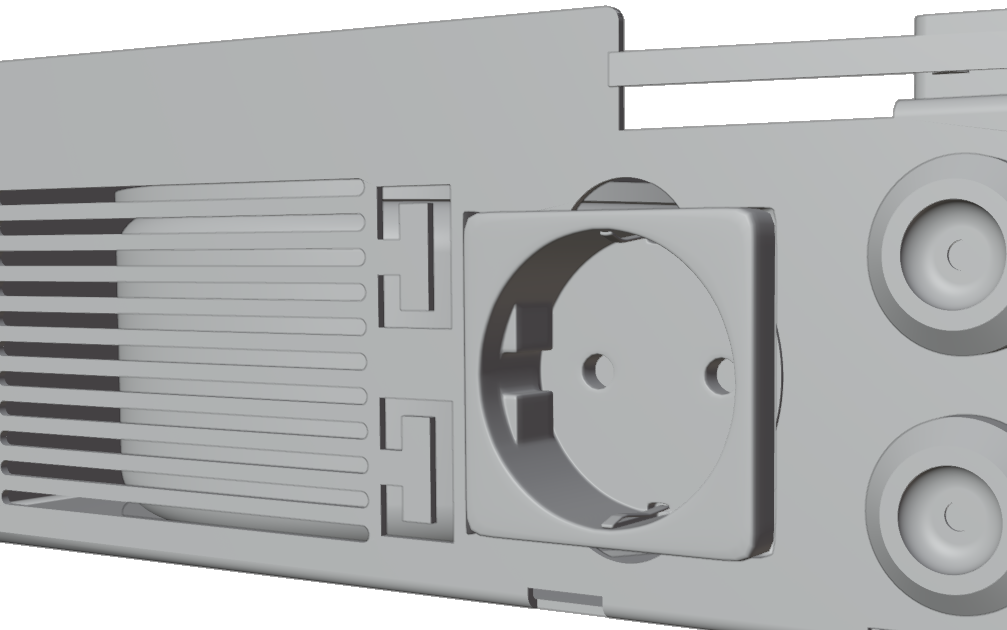
Plug 230 V out
Connect cargo to the outlet on the back of the box. The socket is supplied with backup power and can be energized during battery operation
Connection of supply voltage, 230 V AC
Before connecting, the supply circuit should be disconnected and voltage-free. Verify that the conductor area and cable type meet the applicable installation rules and that the strain relief and insulation levels comply with the requirements for 230 V AC
After connection, all screw connections should be checked and tightened. Tensioning shall only take place after mechanical protection, caps and housing have been reassembled and comply with the contact protection according to EN 62368-1
Important
Installation and connection of 230 V AC may only be carried out by a competent electrical installer according to SS 436 40 00.
L (Phase) — connect the incoming phase conductor.
N (Neutral) — connect the incoming neutral conductor (zero).
PE (Protective Soil) — connect the protective soil to the intended ground terminal. Protective soil is mandatory to maintain the prescribed level of protection of the equipment (protection class I)
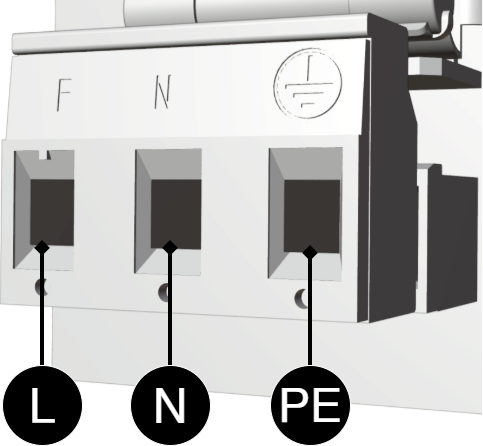
Designation | Explanation |
|---|---|
L | Phase. |
N | Neutral (zero) |
P.E. | Soil. |
Batteries - placement and connection
Connecting batteries
Caution
Batteries can wear out faster than expected when temperatures fall outside the range that is optimal for battery operation.
Important
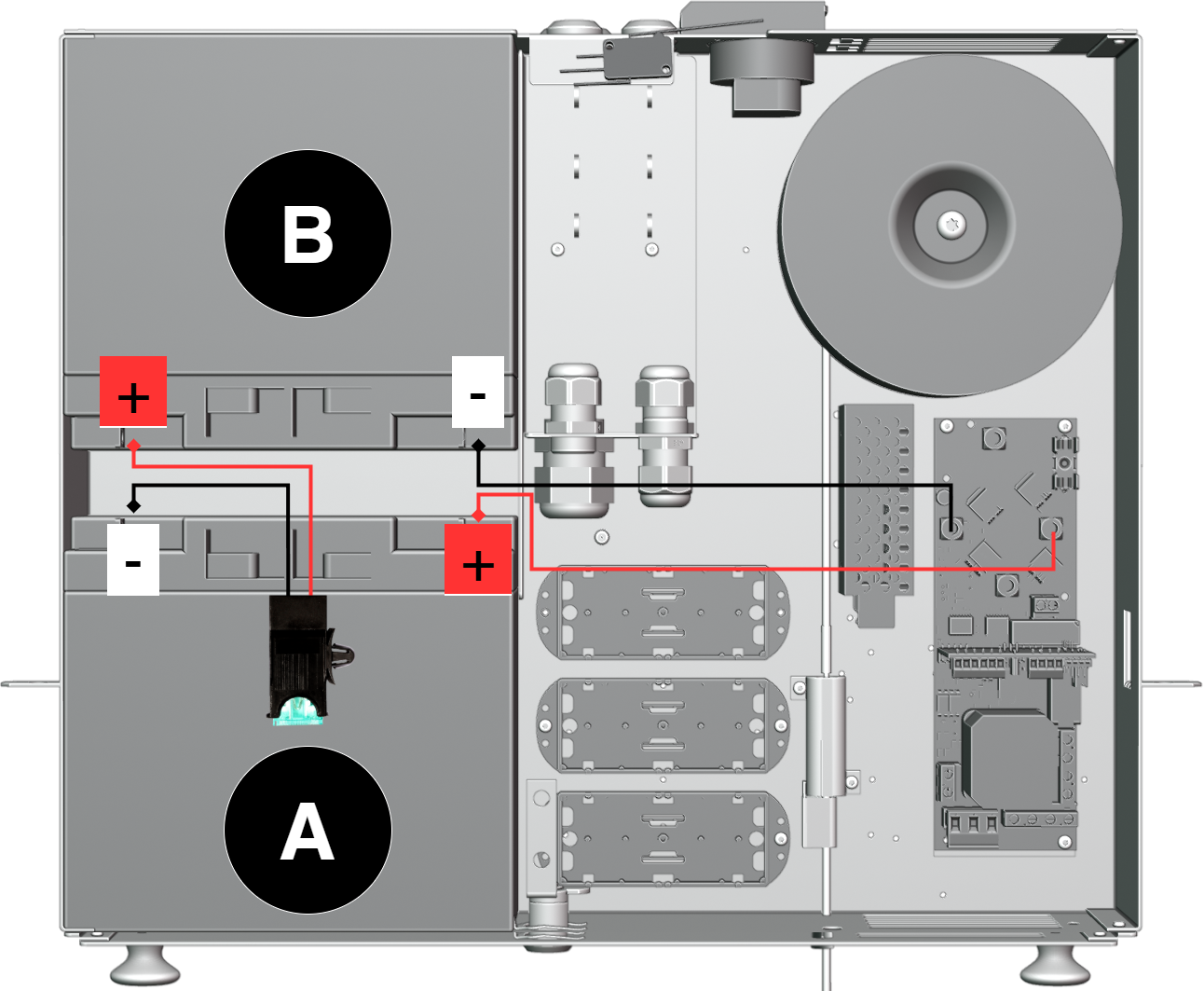
Cover the poles of battery B before mounting battery A. It reduces the risk of short circuit during assembly
Check that the mains voltage is disconnected before connecting batteries.
Check the polarity of the batteries.
Connect the black battery cable to the negative terminal (-) of the battery B.
Install fuse holder on battery B.
Connect red battery cable to battery A's plus (+).
Connect fuse holder on battery A.
Install the battery fuse in the fuse holder.
Make sure that all connections are securely attached and that the polarity is correct.
To deploy the device, follow the steps for deployment.
Deployment - how to start the device
Danger
Personal injury or death can occur if the device is connected to the mains or live when disassembling / moving.
Connect load.
Connect batteries.
Connect mains voltage.
Plug in mains voltage.
Alarm / status on indicator diode
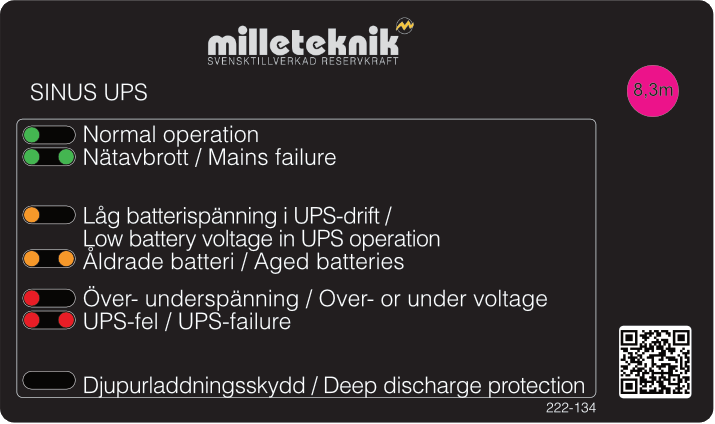
Indication | Text on panel | Explanation |
|---|---|---|
Solid green glow | Normal operation | A green LED lights up. Indicates that everything is working as it should. |
Flashing Green | Mains failure | Indicates that the mains voltage has been broken and the device is battery powered. |
Solid orange glow | Low battery voltage in UPS operation | Warns that the battery capacity starts to run out during battery operation. |
Flashing orange | Aged Batteries | Indicates that the batteries have lost their capacity and need to be replaced. |
Solid red glow | Over-undervoltage/Over- or under-voltage | Indicates that the voltage is outside the permissible limits. |
Flashing red | UPS Failure/UPS Failure | Indicates an internal failure of the UPS device. |
No LEDs on (fully off) | Deep discharge protection | Indicates that the system has turned itself off completely to protect the batteries from harmful deep discharge. |
Safety Information - Service and Troubleshooting, UPS
Disconnect the incoming mains voltage before starting service, battery replacement, measurement or troubleshooting.
Note that the output of the UPS may be energized even when the incoming mains voltage is disconnected. Disconnect connected load and control meter 230 V AC out before starting work.
Remove battery fuse, disconnect battery connector, or turn off automatic fuse before work is performed on the DC side.
Check that the incoming 230 V AC, output 230 V AC, protective ground and battery connections are properly connected before re-energizing the unit.
The product may contain components that become hot during operation. Avoid touching internal parts immediately after power is broken.
If fuses fail repeatedly, disconnect the unit and contact Milleteknik technical support.
In case of suspicion of damage, liquid effects or burnt odour, the product must not be used until it has been checked by competent personnel.
During operation, the housing should be closed and locked, if the device has a lock.
Only authorized service personnel may perform repairs on the device.
Use only original fuses and batteries of the same type and value as specified in the manual or product sheet.
Trouble | Possible cause | Action |
|---|---|---|
No voltage out from the UPS. | Incoming mains voltage is missing, batteries are discharged, battery fuse is missing or load output is disconnected. | Check incoming feed, battery connections, battery fuse and connected load. |
UPS is switching to battery operation. | Incoming mains voltage is missing or is outside the permissible range. | Check the incoming 230 V AC and fuse in the supply circuit. |
Load does not work in case of network outage. | Batteries are discharged, disconnected, miswired or have too low capacity. | Check battery voltage, polarity, battery fuse and battery condition. |
Short backup operation time. | Batteries are not fully charged, aged or the load is higher than estimated. | Allow the batteries to recharge. It can take up to 72 hours for the batteries to be fully charged. Check the load and the condition of the batteries |
Fuse dissolves. | Short circuit, overload, mismatched load or battery cable failure. | Break the incoming mains voltage and check both AC and DC side before replacing the fuse. |
UPS alarms. | Battery failure, overload, mains failure, temperature failure or internal failure depending on the model. | Check the indication, panel or manual for the current alarm declaration. |
The device gets hot. | High load, insufficient ventilation or too high ambient temperature. | Check that the rated current is not exceeded and that air flow is present around the housing. |
If the problem persists after these checks, contact Milleteknik support and provide the product name, serial number and a brief error description.
Product sheet - power supply / battery backup
Product Sheet
SIN - UPS Product sheet / technical data
Item Information
The table shows the name, part number and email number of the product
Product Identification
Product designation | Item No. | E-number (SE) |
|---|---|---|
300W 2HE SINE UPS | 2U02U0021FP003 | 52,137 92 |
Technical description
Compact 2-HE rack-mounted UPS for 19" racks with 300 W continuous power and space for 2 × 12 V 20 Ah batteries. Prepared for communication via relay outputs as well as the possibility of Modbus and compatible with external battery box (4 ×
Areas of application
Areas of application | Yes | No |
|---|---|---|
Designed to ensure uninterrupted operation of critical equipment in security and communication systems. | ✔ |
Electrical data
Electrical data | |
|---|---|
Supply voltage | 230V AC, +/- 10%, 47Hz- 63Hz |
Charge current | Max 5 A |
Voltage out | 230V AC, +/- 10%, 47Hz- 63Hz |
Rated power (W) | 300W |
Battery
Enclosure and Mechanics
Enclosure and Mechanics | |
|---|---|
Type | Enclosure for 19" rack |
IP class | IP20 |
Material | |
Colour | Black |
Height units | 2 |
Cable grommets | 6 pcs |
Lock | ✔ 2 keys included |
Fan in enclosure | ✘ |
Assembly, installation and eligibility requirements
Fitting | Yes | No |
|---|---|---|
19" rack. | ✔ |
Installation | Yes | No |
|---|---|---|
Fixed installation. | ✔ |
Dimensions, weight and packaging information
Net weight | Weight with packaging |
|---|---|
13.0 kg | 13.3 kg |
Packaging | |
|---|---|
Packaging |
|
Quantity in pack | 1 pc. |
Packaging Type (GS1 T0137) | BX box. |
Conditions EUR pallet | EUR pallets may not be stacked during transport or storage. Stacking may result in damage to product and packaging |
Transport environment | The product must be protected from condensation and direct precipitation during transportation. |
Transport temperature (without battery) | −30 °C to +70 °C |
Storage environment | Dry indoor environment, protected from condensation. Relative humidity: max 95%, non-condensing |
Storage temperature without batteries | −20 °C to +60 °C |
About this information
All information is published subject to possible errors. Information is updated without prior notice. |
Publication date 2026-07-01
Compliance and regulatory compliance
Delivery time, warranty and terms
Delivery time, warranty and terms | |||||||||||||||||||||||||||||||||||||||||||||||||
|---|---|---|---|---|---|---|---|---|---|---|---|---|---|---|---|---|---|---|---|---|---|---|---|---|---|---|---|---|---|---|---|---|---|---|---|---|---|---|---|---|---|---|---|---|---|---|---|---|---|
Warranty period[a] | The product has a two (2) year warranty against manufacturing defects. | ||||||||||||||||||||||||||||||||||||||||||||||||
Special warranty conditions | See also general terms and conditions. | ||||||||||||||||||||||||||||||||||||||||||||||||
General Terms and Conditions | ALEM09 with exceptions, see: www.milleteknik.se/conditions/ | ||||||||||||||||||||||||||||||||||||||||||||||||
Support | Telephone support and email support during the warranty period are free of charge. For spare parts that are not covered by warranty, there is a charge | ||||||||||||||||||||||||||||||||||||||||||||||||
Delivery and stock | |||||||||||||||||||||||||||||||||||||||||||||||||
Delivery time[b] | Or as per agreement. Delivery from factory, transportation time is added. | ||||||||||||||||||||||||||||||||||||||||||||||||
[a] If the device is purchased through a wholesaler or other supplier, other warranty conditions may apply [b] In the case of larger orders, delivery time increases, acc. to agreement. | |||||||||||||||||||||||||||||||||||||||||||||||||
Operation and maintenance
Operation | Data | Other. info | |||||||||||||||||||||||||||||||||||||||||||||||
|---|---|---|---|---|---|---|---|---|---|---|---|---|---|---|---|---|---|---|---|---|---|---|---|---|---|---|---|---|---|---|---|---|---|---|---|---|---|---|---|---|---|---|---|---|---|---|---|---|---|
Environment | |||||||||||||||||||||||||||||||||||||||||||||||||
Operating temperature (recommended) | +15°C to +25°C | ||||||||||||||||||||||||||||||||||||||||||||||||
Operating temperature (permissible)[a] | +5°C to +40°C | Class 1 according to EN 50131-6/ EN 60839-11 | |||||||||||||||||||||||||||||||||||||||||||||||
Load, power supply | 80% | Average load shall not exceed 80% of the rated capacity of the power supply. | |||||||||||||||||||||||||||||||||||||||||||||||
Ventilation, in front and behind the enclosure. | 100 mm | Ventilation openings must not be blocked or covered. | |||||||||||||||||||||||||||||||||||||||||||||||
[a] Specifies the permissible ambient temperature range in which the product can operate without damage. See also table on battery life. | |||||||||||||||||||||||||||||||||||||||||||||||||
Yes | No | Interval | Other. info |
|---|---|---|---|
✔ | Annually | Battery terminal voltage must be measured. Ensure that the average load does not exceed 80% of the rated capacity of the power supply. |
Certifications and approvals
Complies with | Directives |
|---|---|
C.E. | CE marking according to (EC) 765/2008 |
EMC | EMC Directive 2014/30EU |
Electric (LVD) | Low Voltage Directive: 2014/35/EU |
Complies with | Yes | No | |||||||||||||||||||||||||||||||||||||||||||||||
|---|---|---|---|---|---|---|---|---|---|---|---|---|---|---|---|---|---|---|---|---|---|---|---|---|---|---|---|---|---|---|---|---|---|---|---|---|---|---|---|---|---|---|---|---|---|---|---|---|---|
EN50081-1, -2, EN55011, EN55022 (B) and EN50082-1, -2, EN61000-4-2, -3, -4, -5. | ✔ | ||||||||||||||||||||||||||||||||||||||||||||||||
The UPS meets the applicable EMC requirements of EN 61000-6-3/6-4 (emission) and EN 61000-6-1/6-2 (immunity). | ✔ | ||||||||||||||||||||||||||||||||||||||||||||||||
EN 62368-1 | ✔ | ||||||||||||||||||||||||||||||||||||||||||||||||
EN 62040-1 | ✔ | ||||||||||||||||||||||||||||||||||||||||||||||||
EN 16005[a] | ✘ | ||||||||||||||||||||||||||||||||||||||||||||||||
[a] SINUS UPS is a backup power unit (UPS) that meets the applicable parts of the EN 62040 standard series. Compliance with EN 16005 refers to the complete door system and rests with the door manufacturer or system integrator | |||||||||||||||||||||||||||||||||||||||||||||||||
Environmental data
Environmental data | J/N | Informație | Other. info. | ||||||||||||||||||||||||||||||||||||||||||||||
|---|---|---|---|---|---|---|---|---|---|---|---|---|---|---|---|---|---|---|---|---|---|---|---|---|---|---|---|---|---|---|---|---|---|---|---|---|---|---|---|---|---|---|---|---|---|---|---|---|---|
Building Product Declaration (BPD) | ✔ | Yes, see iBvd at www.milleteknik.se. | - | ||||||||||||||||||||||||||||||||||||||||||||||
REACH Information Obligation (EC) No 1907/2006 | ✔ | If empty, the product is not covered. | |||||||||||||||||||||||||||||||||||||||||||||||
SVHC substances, CAS/EC | ✔ | For text, see iBvd at www.milleteknik.se. If blank, substance is missing. | |||||||||||||||||||||||||||||||||||||||||||||||
Subject to the RoHS Directive, (EU) 2015/863) | ✔ | ||||||||||||||||||||||||||||||||||||||||||||||||
WEEE 2012/19/EU | ✔ | If empty, the product is not covered. End-of-life products must be returned to a recycling centre | |||||||||||||||||||||||||||||||||||||||||||||||
Battery Regulation (EU) 2023/1542 | |||||||||||||||||||||||||||||||||||||||||||||||||
SCIP No 2008/98/EC | ✔ | If empty, no SCIP number is needed. | |||||||||||||||||||||||||||||||||||||||||||||||
Conflict minerals (EU) 2017/821 | ✗/✗/✗/✗/✔ | No=Gold, Tungsten, Tantalum, Cobalt. Yes=Tin | Tin in solders in printed circuit boards purchased through a Swedish supplier. | ||||||||||||||||||||||||||||||||||||||||||||||
Contains nanomaterials: EC 1272/2008 | ✗ | The product does not contain nanomaterials. | |||||||||||||||||||||||||||||||||||||||||||||||
Ecodesign 2009/125/EC | Milleteknik's products are intended for professional use and are therefore not directly covered by the Ecodesign Regulation (EU 2019/1782). As some components may be covered, we nevertheless disclose relevant information[a], where applicable, to provide our customers with confidence in their choice. | ||||||||||||||||||||||||||||||||||||||||||||||||
Machine Directive 2006/42/EC | The product is part of electrical systems, is subject to the relevant electrical and safety directives and is not a machine according to the Machinery Directive (2006/42/EC). Will be replaced by Machinery Regulation (EU) 2023/1230, which will apply in 2027. | ||||||||||||||||||||||||||||||||||||||||||||||||
[a] Standby consumption and power. | |||||||||||||||||||||||||||||||||||||||||||||||||

Manufacturer and country of origin
Appendix
Backup operating time on batteries
The reserve operating time in battery operation depends on how large a load is connected to the power supply. If the load varies, as with frequent opening of door locks, the time that batteries can continue to power the security system decreases. To get an estimate of reserve operating times see: www.milleteknik.se/Manualer/FaQ/Reservdrifttider/
Eligibility requirements, installation
Eligibility requirements vary between countries. The table summarizes national requirements for fixed installation and connection of equipment with a plug socket, respectively.
Options on the secondary side of the product, such as 12 V, 24 V or 48 V DC, are connected according to the respective instructions. Work on the network connection of the product shall be carried out in accordance with national eligibility requirements
Permission Requirements for Installation | Fixed installation (230 V) | Plug | Other. info |
|---|---|---|---|
Sweden | ✔ | ✗ | Fixed installation may be performed by technicians but shall be under the responsibility of a qualified installer. (Electrical Safety Act, SS 436 40 00) Plug may be connected without authorization. |
Norway | ✔ | ✔ | Requirements for qualified electricians also for equipment with a plug socket in fixed installations. (NEK 400, DSB |
Finland | ✔ | ✗ | Plug may be connected without authorization. (Tukes, SFS 6000 |
Denmark | ✔ | ✗ | Plug may be connected without authorization. (Safety Board |
Germany | ✔ | ✗ | All fixed installations require a qualified electrician according to VDE 0100. Plug sockets may be connected without authorization, but only by person with basic electrical knowledge (“Elektrotechnisch unterwiesene Person”) |
Reference table: environmental classes according to EN 50130-5 (referred to in EN 50131-6)
Class | Type | Temperature range |
|---|---|---|
Environmental Class 1 | Heated indoors (type office/residence). | +5°C to +40°C |
Environmental Class 2 | Generally indoors (type warehouses/stairwells, not temperature controlled). | -10°C to +40°C |
Environmental class 3 | Protected outdoors. | -25°C to +50°C |
Environmental class 4 | Generally outdoors. | -25°C to +60°C |
Reference table: manufacturer's stated service life and recommended battery replacement
Battery Type (Design Life)[a] | Battery replacement time in normal operation, +20°C. | Replacement during hot operation, +30°C | Replacement during hot operation, +40°C | ||||||||||||||||||||||||||||||||||||||||||||||
|---|---|---|---|---|---|---|---|---|---|---|---|---|---|---|---|---|---|---|---|---|---|---|---|---|---|---|---|---|---|---|---|---|---|---|---|---|---|---|---|---|---|---|---|---|---|---|---|---|---|
3 - 5 years | 2 - 3 years | 1 - 1.5 years | 0.5 - 0.75 years | ||||||||||||||||||||||||||||||||||||||||||||||
6 - 9 years | 5 - 6 years | 2.5 - 3 years | 1.2 - 1.5 years | ||||||||||||||||||||||||||||||||||||||||||||||
10 - 12 years | 6 - 7 years | 3 - 3.5 years | 1.5 - 1.75 years | ||||||||||||||||||||||||||||||||||||||||||||||
15 + years | 10 - 12 years | 5 - 6 years | 2.5 - 3 years | ||||||||||||||||||||||||||||||||||||||||||||||
[a] Valid in case of completely unused battery stored under optimal conditions. | |||||||||||||||||||||||||||||||||||||||||||||||||
About this information
All information is published subject to possible errors. Information is updated without prior notice. |
Publication date 2026-07-01
Address and contact details
Milleteknik AB |
Ögärdesvägen 8 B |
S-433 30 Partille |
Sweden |
+46 31 340 02 30 |
info@milleteknik.se |
www.milleteknik.com |
[1] Translations in languages other than Swedish are indicative only and not verified. Translation should always be checked against the Swedish original to ensure accurate information